


The prestigious Picchi Awards, supported by the Picchi Brothers Foundation, aim to inspire and encourage the next generation of cancer research leaders.
Three outstanding PhD students are chosen from the categories of basic science, clinical science and population health each year. The award winners receive $10,000 to learn and build networks, providing support towards research independence.
The awards are available to PhD students who have confirmed candidature at a University affiliated with a VCCC Alliance member organisation and undertaking cancer-related research training within a VCCC Alliance member organisation at the application closing date.
Population Health: Anu Mary Oommen
Evaluation and Implementation Science Unit, Center for Health Policy, Melbourne School of Population and Global Health, University of Melbourne
Co-designing and testing scalable programmatic approaches to HPV-based cervical screening in vulnerable populations in India - implementation research
Clinical Science: Dr Hannah Walker
Murdoch Children’s Research Institute; The Royal Children’s Hospital; University of Melbourne
BREATH: Breathe Easier after Allogeneic Transplantation (Haematopoietic): Pulmonary biological profiling in children post allogeneic haematopoietic stem cell transplantation (allo-HCT): understanding infectious and non-infectious complications
Basic Science: Kah Min Yap
Peter MacCallum Cancer Centre; The Sir Peter MacCallum Department of Oncology, University of Melbourne
Identifying Optimal Tumour-specific Promoters for CRISPR/Cas9 Engineering of Armoured CAR T Cells with Enhanced Safety and Efficacy
Population Health: Nicola Creagh
Melbourne School of Population and Global Health, Centre for Health Policy, University of Melbourne
Evaluating the implementation of a universally available choice for self-collection cervical screening in Australia: the solution to improving equity?
Clinical Science: Julia Lai-Kwon
Peter MacCallum Cancer Centre; Sir Peter MacCallum Department of Oncology, University of Melbourne
Co-design of an electronic patient-reported outcome symptom monitoring system for people receiving immunotherapy
Basic Science: Marina Yakou
Olivia Newton-John Cancer Research Institute, School of Cancer Medicine, La Trobe University
Tissue-dependent dichotomy in IL-15 mediated anti-tumour immunity to colorectal cancer
Clinical Science: Aaron Wong
St Vincent’s Hospital; The Royal Melbourne Hospital; Peter MacCallum Cancer Centre; the University of Melbourne
Accelerating pharmacogenomic guided opiod prescribing into clinical practice in cancer patients
Basic Science: Amanda Chen
Peter MacCallum Cancer Centre
CRISPR/Cas9 engineering of next generation armoured CAR T Cells
Population Health: Rachel Delahunty
Peter MacCallum Cancer Centre; the University of Melbourne
Reducing the morbidity and mortality of ovarian cancer through prevention
Clinical Science: Irene Deftereos
Western Health; the University of Melbourne
Investigating current evidence and practices for improving the nutritional status and outcomes of patients undergoing resection of upper gastrointestinal cancer.
Population Health: Asha Bonney
The Royal Melbourne Hospital
Lung cancer screening with low dose computed tomography (LDCT); exploring opportunities to optimise disease prevention across a range of health outcomes in Australia
Basic Science: Wenxin Hu
Peter MacCallum Cancer Centre
Reprogrammed CRISPR-Cas13 suppresses tumour RNAs with single-nucleotide precision
Basic Science: Kenji Mark Fujihara
Peter MacCallum Cancer Centre
The determinants of sensitivity and mechanisms of action of APR-246 (Eprenetapopt)
Population Health: Martin Vu
The University of Melbourne
Using real-world evidence to assess the clinical utility of high-throughput sequencing technologies: the pursuit of precision medicine for haematological malignancies
Clinical Science: Stacie Shiqi Wang
WEHI; Children’s Cancer Centre, Royal Children’s Hospital
Chimeric antigen receptor T cell therapy in paediatric high-grade glioma
Basic Science: Stefan Bjelosevic
Peter MacCallum Cancer Centre
Investigating FMS-like tyrosine kinase 3 (FLT3)-induced metabolic reprogramming in acute myeloid leukaemia
Clinical Science: Deborah Meyran
Peter MacCallum Cancer Centre
New CAR-T cells to enhance paediatric immunotherapy
Population Health: Matthew Grant
St Vincent’s Hospital; Palliative Nexus Research Group, the University of Melbourne
An exploration of informal communities in cancer treatment
Basic Science: Amanda Oliver
Peter MacCallum Cancer Centre
Tissue-specific tumour microenvironments and their impact on immunotherapy responses
Clinical Science: Edward Chew
Walter and Eliza Hall Institute
Identification of novel genetic drivers in the development of acute myeloid leukemia
Population Health: Sibel Saya
The University of Melbourne
The acceptability, feasibility and clinical utility of a genomic profile to target screening for colorectal cancer
Basic Science: Ms Simone Park
The University of Melbourne - Doherty Institute
The role of tissue-resident memory T cells in melanoma immune surveillance
Clinical Science: Dr Jonathan Hiller
Peter MacCallum Cancer Centre
Exploring perioperative adjunctive therapies that can be utilised during cancer surgery to improve cancer outcomes
Population Health: Dr Shuai Li
The University of Melbourne
DNA methylation and breast cancer risk factors: insights from twin and family studies
Basic Science: Rebecca Delconte
Walter and Eliza Hall Institute and University of Melbourne
Targeting Regulators of Natural Killer Cell Homeostasis in Cancer Immunotherapy
Clinical Science: Kathryn Field
Peter MacCallum Cancer Centre, Royal Melbourne Hospital and the University of Melbourne
Towards the further understanding of prognosis and outcomes for patients with high grade gliomas: A randomised phase II study of Carboplatin and Bevacizumab in Recurrent Glioblastoma (CABARET study)
Population Health: Kevin Nguyen
The University of Melbourne
Breast cancer associations with mammographic density defined by higher pixel brightness thresholds
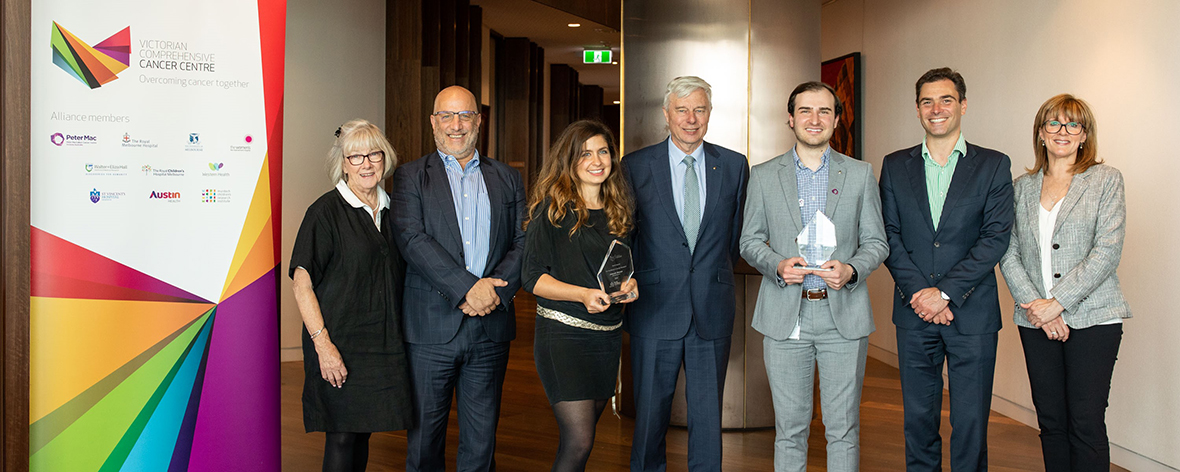
Image: Most recent live award ceremony featuring winners of Picchi Awards 2020.