


Research
We are driving the next generation of discoveries to address critical cancer challenges and accelerate the translation of scientific evidence into patient benefit.
Education
Fostering an outstanding cancer care workforce to help maintain and enhance world-leading patient outcomes through online learning, courses and events.
Equity
Pursuing equity in access to cancer care and outcomes for all Victorians affected by cancer.
Consumer Engagement
Partnering with consumers at every step of our journey, because no-one knows cancer like someone who’s lived it.
About us
Research, academic and clinical institutions working together to accelerate cancer research, knowledge and expertise to benefit all.
News & Events
The VCCC Alliance brings you the latest in cancer research, education and clinical care through engaging, relevant and informative events.

Trial Risk Assessment and Management

Responsibilities and process for developing a trial risk assessment and management plan.

Who is responsible for managing risk in a clinical trial?

The Sponsor-Investigator is responsible for evaluating all risks to participants and the trial data before the trial starts and developing a plan to control the risks to an acceptable level. 

Risk identification

During protocol development, the Sponsor-Investigator should identify risks to:
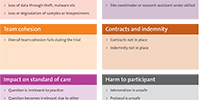
  • Trial participants, e.g. harms related to the trial intervention, trial procedures, serious breaches 
  • Conduct of the trial, e.g. trial inadequately powered, poor recruitment, inadequate safety monitoring, inadequate data collection, inadequate data management systems

Download Different types of risks

Download the different types of risk that affect clinical trials.

Risk assessment and control

After identifying the risks, the Sponsor-Investigator should develop a trial-specific Risk Assessment and Management Plan. The outputs from this activity may be used to support an application for trial sponsorship by an institution/organisation.  

An assessment of risks and associated control measures requires the Sponsor-Investigator or a delegated member of the research team to:

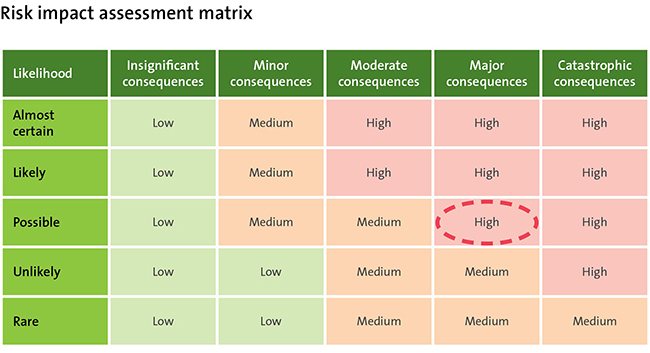
  • Assess all identified risks in terms of the likelihood and severity/impact of the potential harm on participants (safety, rights and well-being) and the reliability of the trial results. Assess each risk individually using a risk matrix to assign the impact for the risk of low, medium or high. 

For example, using a risk impact assessment matrix table (example provided below),  a risk that has a possible likelihood of occurring and major consequences for the study outcome and/or for the organisation if it was to occur, is categorised as having a  high risk impact.
  • Manage and monitor the risks - establish a plan to reduce risks to an acceptable level and review the risks regularly throughout the trial. 

Risk impact assessment matrix

Documenting the trial-specific risk assessment and management plan

The risk assessment and management approach must be documented in a formal Risk Assessment and Management Plan and be updated if there is any change in risk - either to a risk that was identified before the trial commenced or new risks that arise during the conduct of the trial.  

This essential document should be version controlled and maintained in the Trial Master File (TMF). Note some Human Research Ethics Committees require the Risk Assessment and Management Plan be submitted at the time the protocol is submitted for ethics approval.   

The risk-reduction activities identified during the risk assessment and risk management planning, should be incorporated into the protocol design, clinical monitoring plan, safety monitoring plans, trial-specific standard operating procedures/processes, and staff training.  
National guidelines

International guideline

Get the latest in cancer news, events and more, direct to your inbox

Join a network of Victorian cancer researchers, clinicians and consumers to keep your finger on the pulse.